

AIPAC is a Paper Tiger
The Israel Lobby is very powerful, but that power is derived much more from image than reality.

Cutting Through is here to provide fresh and clear analysis you don’t get in most media. But we can only do that with your help. If you can, please donate through CashAPP, using the button below. Or become a paid subscriber by clicking on the subscribe link!
If you can’t do those things, supporting this work by spreading the word, bringing new subscribers, free or paid, is a great way to help move this work forward.
All your support, and everything you do, is appreciated!
To become a free or paid subscriber, just click this button.
You can also support this site with a one-time donation, rather than—or in addition to—a subscription, through CashApp, by clicking this button.
To share this newsletter with your friends, just click this button.
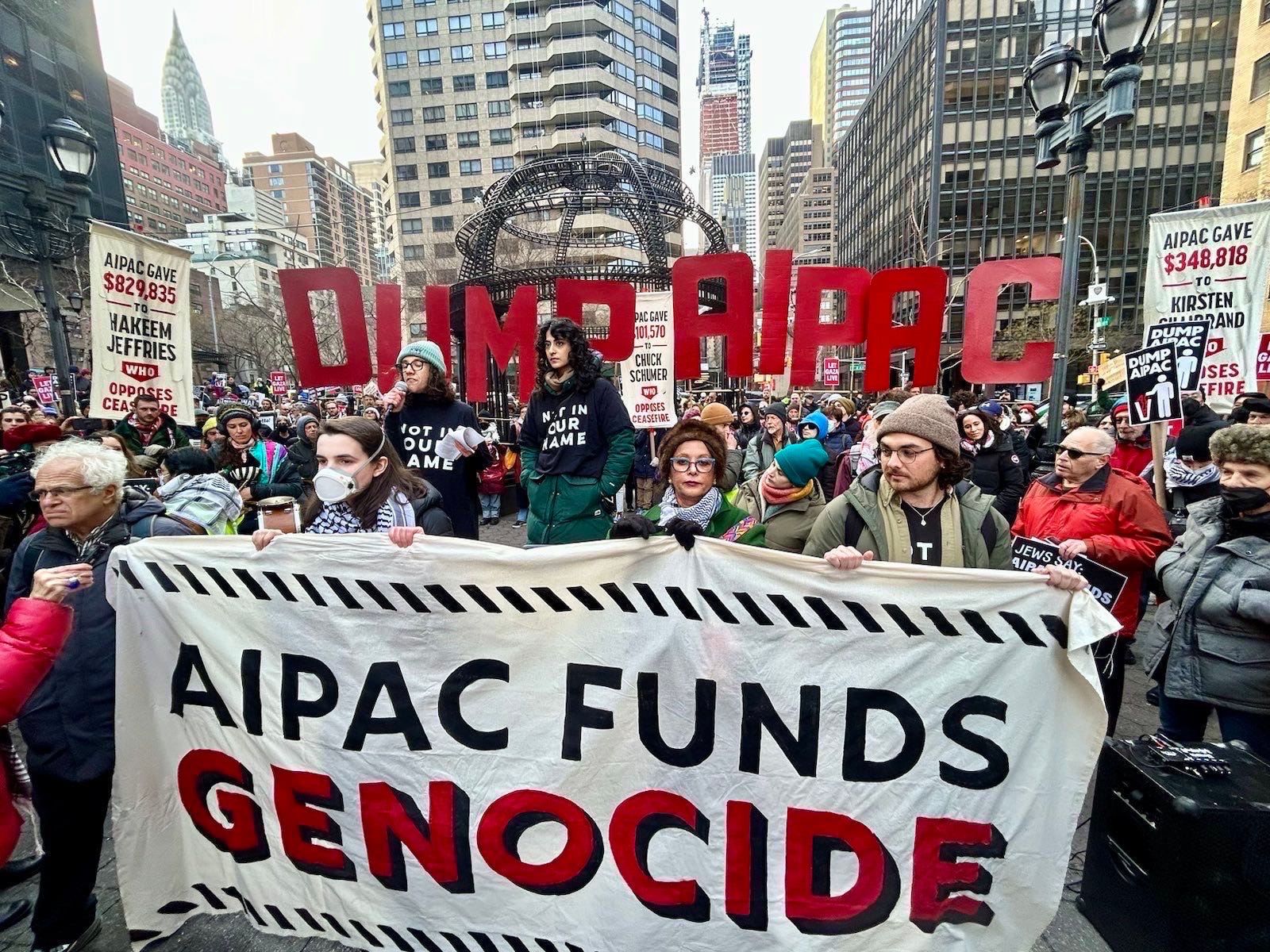
There is welcome attention being paid to the role of campaign financing in politics. Nowhere is this clearer than in the growing popular disgust with American policy toward Israel.
The leading pro-Israel lobbying group, the American-Israel Public Affairs Committee (AIPAC) has become a symbol of everything wrong with American politics. It stands for politicians acting against the express wishes of their constituents, and for shady, dishonorable, and dishonest tactics to achieve its goals.
But the unusual thing about politics, especially regarding lobbying and campaign financing groups, is that real power is often derived as much from perception as reality. As much as AIPAC and other pro-Israel campaign financing groups spend on elections, it is a drop in the ocean of overall campaign spending. Yet the impact of this lobby is obviously real.
I would argue that real impact is exaggerated, affording politicians cover for bad and unpopular policy decisions. It’s also very much the case that the Israel Lobby does not make or determine policy, but it does influence it, and it blocks any serious challenge to entrenched pro-Israel policy in Congress. That’s not where policy is made, but it is the place where debate and competing legislation can change the politics around a given policy.
But it’s a circular process. On one hand, AIPAC’s power in terms of its real ability to affect elections may be exaggerated, but perception is the source of its power. In other words, the fear of AIPAC, and its partners in slime, more than their actual capabilities is what gives the Israel Lobby it’s disproportionate power in Washington.
The perception of the Israel Lobby’s power isn’t just made up. It’s been carefully crafted over many years. But it can be confronted and defeated much more easily than most in Washington believe. Indeed, sometimes even supporters of Palestinian rights help in hyping the image of a nearly omnipotent lobby. That’s obviously self-defeating, but it’s also a false perception, and one we need to tear down.
Building the fearsome paper tiger
The Palestine solidarity movement has done a commendable job of organizing and thereby promoting popular opposition to American policy toward Israel and Palestine. Sadly, that success has not yet been matched in the area of political campaigns.
It’s been frustrating for people who have tried. The story of Rep. Maxwell Frost is telling.
Palestine solidarity activists, some of whom I have spoken to directly on this matter, worked tirelessly to support and elect Frost, who made history in 2022 as a 25-year old and the first Gen Z member of Congress.
Frost had built that support network of activists through his own activism. Though primarily focused on gun violence in his early activism, he supported the Boycott, Divestment, and Sanctions movement, signed a call for ending military aid to Israel, and defended anti-Zionism. During his campaign, however, he sharply reversed all of those positions.
By congressional standards, Frost remains a relative moderate on Palestine, but his reversal was correctly seen as a betrayal and an act of supreme political cowardice.
In the questionnaire from the center-right publication Jewish Insider that Frost responded to where he changed his positions, he cited Ritchie Torres and Mondaire Jones as political mentors. Torres and Jones are major recipients of pro-Israel money, and stand out as pro-Israel propagandists who have also used their personal identities as men of color and, in Torres’ case, a gay man, to help AIPAC create the illusion of a diverse pro-Israel coalition that doesn’t really exist.
Why did Frost do this nearly 180-degree turn? Because in a single Florida district, AIPAC is quite capable of pumping a massive amount of money to smear a candidate. That’s generally what most Democrats fear.
We saw AIPAC do just that in 2024, as they targeted Cori Bush and Jamaal Bowman, and saw both go down to defeat. Yet those very elections also exposed the weakness of pro-Israel campaign financing.
Money in politics is only as valuable as the votes it buys
Raising more money by no means equals victory, despite what one might glean from the way the media salivates over fundraising in campaigns.
There is no doubt that money helps, especially in local elections. In some cases, especially with candidates who depend on copious amounts of small donors rather than a few big ones, fundraising can be a real mark of a politician’s popularity and potential success. Other times, it can be misleading to the public and represent fool’s gold for the politician who forgets that it’s votes, and not money, that win elections.
Most people are not terribly familiar with their own congressional representatives unless they’ve been in office for a long time. It’s why, despite the widespread disdain for Congress, incumbents still have a great advantage. Name recognition goes a long way, and advertising greatly boosts name recognition, while simultaneously projecting the image the candidate wants to project. Money is obviously key to that kind of exposure.
And enough money can buy enough propaganda to demonize an opponent. In 2024, AIPAC pumped massive amounts of money into defeating Cori Bush and Jamaal Bowman. Meanwhile, although AIPAC was deeply involved in a few other races, they spread most of the rest of their resources out more widely and thinly, enough to ensure access to hundreds of congressional offices, but not enough to be a serious factor in the races.
In Missouri, Bush’s opponent was able to outspend her by a nearly 4 to 1 margin, which included over $8 million from AIPAC, a huge sum in a single congressional district. Yet Bush made it a close race, losing by less than 7,000 votes.
Bowman’s loss was even more instructive. He lost by 17 points to an extreme conservative (among Democrats), George Latimer after pro-Israel groups pumped the insane figure of $15 million not that race, with another $10 million in outside money joining in.
Bowman also had to contend with a divided district which had been redrawn to include more affluent and conservative voters who were not keen on Bowman’s agenda. It’s not at all clear that he wouldn’t have lost regardless of AIPAC, or, conversely, that even all that money would have been enough to defeat him if his district had not been redrawn.
That point is telling. There is a reason why members of Congress who are much more influential, and would therefore be more important for AIPAC to oust, are not even challenged by the Israel Lobby. AIPAC would trade a hundred victories over a Cori Bush to eliminate someone like Chris Van Hollen or Bernie Sanders from the Senate or even someone like Alexandria Ocasio-Cortez from the House. AOC, if you’re wondering, is not nearly as outspoken on Palestine, but she is key to getting a more progressive view out into mainstream American politics. (It’s worth noting that Democratic leadership also failed to support Bush and Bowman, which was another reason why AIPAC saw them as vulnerable).
But AIPAC doesn’t challenge stronger candidates because they can’t afford to. The pro-Israel lobby more broadly does not have anything like the resources the financial sector, the pharmaceutical industry, the insurance industry, AARP, or other big lobbying groups have. They can’t afford to throw vast amounts of money at races that they lose.
For the most part, AIPAC backs candidates they already know are going to win. In fact in the 2024 election, AIPAC donated money in 389 of the 469 congressional races. Of those 389, 145 either did not hold primaries or the primary races were uncontested. In most of the others, AIPAC backed a sure or almost sure winner. It’s what they have always done. They are not usually buying races; they are buying access. Bush and Bowman, like some others before them, are the exceptions.
Ilhan Omar, Summer Lee, and some other congresspeople have withstood AIPAC attacks, and when that happens, it’s a real body blow to the fearsome lobby precisely because they depend much more on their image as kingmakers than on their actual ability to oust any member they want.
Money in politics in general is only worth the votes it buys. In 2024, Kamala Harris and Donald Trump raised a staggering $4.7 billion. Of that figure, Harris (along with Biden before her) raised $2.9 billion, easily outpacing Trump’s $1.8 billion. As we saw, it didn’t help.
So why is AIPAC so intimidating?
AIPAC games all of this brilliantly. They focus their limited resources in races where they believe it will make the biggest difference, send the loudest message about how much politicians need to fear the Israel Lobby, and where they can avoid actually talking about the policies they want to promote.
AIPAC doesn’t just donate to campaigns, they pay for campaign advertising. It tells you all you need to know about how well AIPAC understands the poor light in which most Democrats see Israel that their ads almost universally avoid any mention of Israel, Palestine, or the Mideast. Indeed, they often don’t even discuss foreign policy. That’s what you do when you know your cause is a loser.
It's even more telling that a lot of the money AIPAC pumps into these races comes from Republican donors.
That’s important because Republican views of Israel are less malleable than Democrats’. Much of the Republican support comes from the Christian Right, the so-called Christian Zionists. That sector doesn’t need an AIPAC, or its evangelical partner Christians United for Israel (CUFI) to sustain their support for Israel and to vote accordingly. Jewish Republicans tend to be extreme supporters of Israel’s right and far-right wings.
Other Republican sectors support Israel based on their fear of Muslims, or their love of an American ally militarily dominating the Middle East. There is also Republican opposition to Israel based on isolationism or, in some cases, antisemitism.
All of those are fairly rigid positions that, to the extent they might ever change, are not likely to be influenced by a group like AIPAC.
But Democratic popular support for Israel has always depended heavily (although not exclusively) on the image of Israel as an American ally; a country with liberal, even progressive values; and as a sympathetic home to a persecuted people.
It’s been a long time since there was a credible case for Israel as a key geo-strategic ally. As we have seen with Iran, Israel increases tensions for the United States and, for all its bluster, it cannot act as an agent of the U.S. against a perceived enemy (an enemy, n this case, that would be a lot easier for the U.S. to work something out with if not for Israel), but needs direct U.S. involvement.
Shared values? Maybe for the racist, Islamophobic, and violent sectors of America that are all too large and all too vocal when Donald Trump is in the White House, but certainly not for most liberals and moderates. Over the past decade, and especially since the genocide in Gaza began, Israel’s image among Democrats has plummeted because it never reflected the values it claimed to, and the illusion that most American liberals and centrists labored under has been shattered by Israel’s hubris in dropping the effort to hide its crimes.
CNN’s Harry Enteen showed this recently when he reported on a Quinnipiac poll that showed a massive 56-point swing among Democrats as to whether they were more sympathetic to Israel or the Palestinians. In just eight years, Israel went from +13 to -43 in the poll. That’s unheard of, but it’s what happens when an illusion crafted over decades bursts.
What does all this add up to?
Bernie Sanders and Ben Rhodes have it right. Democrats should boycott AIPAC, and they should start supporting sensible U.S. foreign policies. They should be expected to reject AIPAC funding, and they should be called out when they don’t.
They should support policies like an immediate end to all U.S. support for the genocide in Gaza. That is a politically feasible position for any Democrat. A simple call for equal rights for all people in Israel and Palestine (mustn’t say “from the river to the sea,” heavens, no), and policies that back that up is the next step. An immediate review of all arms sales and grants to Israel to ensure that they conform to the Arms Export Control Act and the Foreign Assistance Act should quickly follow.
None of these are radical suggestions, and none should be cause for concern for Israel if it really is a state of laws, and of so-called “liberal values.”
But what about the political threats AIPAC can mount? Again, money only goes so far, and that’s all they have. We all need to support Democratic candidates who will back these values, from Rashida Tlaib to Zohran Mamdani to Sanders. We must encourage them all to go farther than they have, but we can only do that if we can have their backs.
We need to call out every ad “paid for by United Democracy Project,” or by AIPAC-PAC two AIPAC’s political action committees so that no Democrat wants to see those ads supporting them. It can work, and if there is a broad effort to make it happen, it will.
Democrats don’t need AIPAC money to win, and they can overcome AIPAC money in opposition. To correct a favorite tag line of the pro-Israel lobby, “Supporting Israel is bad politics and bad policy.”
My Recent Articles
Film Review: James Gunn’s Superman cements Israel’s villain status in the American imagination
James Gunn’s new Superman movie, which draws an analogy between Israel and the villainous country of Boravia, demonstrates how Israel's idealized image in American culture has been shattered by the widespread acknowledgment of Palestinian oppression.
Mondoweiss, July 18, 2025
News Roundup
Saudi Arabia told US that Syrian forces should deploy to Sweida despite Israeli objections, source says
By Sean Mathews and Ragip Soylu, Middle East Eye, July 18, 2025
GHF Guards Gassed Starving and Fenced in Palestinians, Causing a Deadly Stampede
By Sharif Abdel Kouddous, Drop Site News, July 17, 2025
Why Do Our Politicians Care More About Israel Than Americans?
By Prem Thakker, Zeteo, July 17, 2025
Is the international community finally speaking up about Israel?
Al Jazeera, July 18, 2025
‘I haven’t been here in 40 years’: Emotional reunions as Druze cross Israel-Syria fence
By Oren Ziv, +972 Magazine, July 18, 2025
I’m a Genocide Scholar. I Know It When I See It.
By Omer Bartov, New York Times, July 15, 2025
Why "Two States" Is Absurd
By MJ Rosenberg, US Politics, Israel-Palestine, and AIPAC's Awful Power, July 18, 2025
Will the Government Ever Do Right by Mahmoud Khalil?
By Elie Mystal, The Nation, July 15, 2025
As always, follow me on:
Twitter @MJPlitnick or
Bluesky @mjplitnick.bsky.social for my latest hot takes, comments, and news updates.
I also post occasionally on these sites:
Threads @mjplitnick
Mastodon @MitchellPlitnick@journa.host
Instagram @mjplitnick