

Human Rights Watch Sidelines Report on Palestinian Right of Return
Two key employees at HRW quit over the indefinite delay in releasing the report. The incident highlights the importance of bring the conversation about the Palestinian right of return to the forefront

Cutting Through is made possible by your support; it is the only support Cutting Through gets. So please, if you haven’t already, help by becoming a paid subscriber at the link below.
You can also make a one-time or recurring donation by clicking the button below, if that works better for you.
If you can’t do those things, supporting this work by spreading the word, bringing new subscribers, free or paid, is a terrific way to help move this work forward.
All your support to keep this site going and keep it completely free is appreciated!
My Recent Articles and Media
VIDEO: Israel Confirms Palestinian Casualty Figures for Gaza Are Correct
Last week, Israel confirmed what everyone already knew: the casualty figures from Gaza's Ministry of Health are accurate. Why did Israel decide to make this admission now and what does it really mean? This video explores these questions.
YouTube, January 30, 2026
The U.S. occupation of Gaza has begun
The plans for Donald Trump’s “Board of Peace” show that the goal is not just to make Gaza a playground for the wealthy, but to put it under permanent American occupation.
Mondoweiss, January 30, 2026
Omar Shakir had been banned from Israel and Palestine for years for his dogged research for Human Rights Watch (HRW) into human rights abuses committed by Israel and by Palestinian Authority and Hamas forces. Milena Ansari had, at least since 2024, been HRW’s Israel and Palestine Assistant Researcher. Both recently resigned their positions at HRW.
They quit because HRW pulled a report they had authored that made the case that Israel’s denial of the return of Palestinian refugees to the places from which they had been driven out qualified as a crime against humanity. HRW claims the report needed more substantiation. Shakir and Ansari insist that it had gone through HRW’s strenuous process and was ready for release in December until HRW’s new executive director pulled it.
You can read all about the details in this excellent report from Jewish Currents here.
But beyond the dispute over HRW’s handling of the report, there is another point that bears examination. The question of the right of return itself.
The right of return is a central issue in the question of Palestine, yet it is by far the one that is discussed the least. Yet no issue is more central to Palestinian identity and national consciousness. At the same time, on no issue is the gulf between even the most accommodating Palestinians and moderate Israelis nearly as vast.
The right of return, I have long argued, is, at the best of times, the time bomb that threatens to derail any resolution of Israel’s apartheid existence and its refusal to allow Palestinians the rights every human being is entitled to. The fact that it has been ignored in most of the (non-Palestinian) diplomatic, academic, and political discourse is an intolerable and foolish reality.
This eruption at HRW is the latest example of that foolishness. HRW technically supports the right of return as a matter of law because, under international law, it is unquestionably a right to which Palestinians are entitled. But it has always shied away from talking about that right, even when it has been willing to take on loaded issues like Israel’s genocide in Gaza and its apartheid nature.
That sort of attitude among human rights NGOs, and anyone who claims to support Palestinian rights must not be tolerated. Granted, it’s the thorniest issue, because in practice, the right of return means the negation of an enforced Jewish majority in Israel and, therefore, means that Israel must either become a visibly apartheid state of a minority of its citizens or must be willing to abandon its insistence on artificially maintaining its Jewish majority.
But if we give in to the natural temptation to avoid the most difficult conversation—even more understandable on this issue where even the simplest conversations are fraught with pain, injustice, rage, and cultural sensitivity—we only doom ourselves to face an even more complicated question later.
The sidelining of the right of return
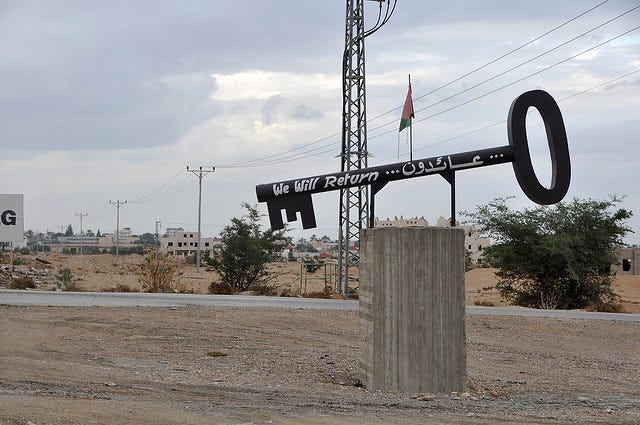
For years, Palestinians have insisted that the right of return is a central issue. It is the very core of Palestinian identity, often symbolized by Palestinian families keeping keys to the houses their ancestors were forced to abandon.
But this has never been reflected in the diplomatic arena. How many times have we heard diplomats—Israeli, American, European, Arab—say, with a wink, that Palestinians “understand” that they will have to give up the right of return if they ever hope to achieve self-determination?
Few indeed are the Palestinians who agree with that assessment. Yet diplomacy and international discourse has continued to sideline the issue of return. The last time it held any sort of prominent mention was in 2002, when the Arab Peace Initiative included it as a condition a “just solution to the Palestinian Refugee problem to be agreed upon in accordance with UN General Assembly Resolution 194.”
UNGA 194 reads, in part, “refugees wishing to return to their homes and live at peace with their neighbours should be permitted to do so at the earliest practicable date, and that compensation should be paid for the property of those choosing not to return and for loss of or damage to property which, under principles of international law or equity, should be made good by the Governments or authorities responsible.”
That is one of the bases of the right of return. There are others, such as the Universal Declaration of Human Rights, the International Covenant on Civil and Political Rights and the Fourth Geneva Convention.
Since I have not been able to see their paper, I can’t say whether Shakir and Ansari successfully argued that Israel’s prevention of the return of refugees constitutes a crime against humanity, although given the quality of their work over the years, I have faith in what they produced. I can, however, say that the prevention of the return of refugees is a clear violation of international law and, considering the impact that violation has had for more than 75 years and continues to have to this day, it’s a damn serious one.
But this issue continues to be sidelined, and that is a terrible mistake. If there is ever to be a resolution that finally sees Palestinians achieve their freedom and rights, it will come from some kind of agreement. And, while this moment we are in is so grim that even dreaming about resolutions is naïve at best, it is awful to imagine Palestinians and Israelis digging themselves out of this horrific morass to find mutually agreeable solutions only for the right of return to then scuttle the whole deal.
And it would do just that if it is not treated with a lot more seriousness not only by Israel but by every actor except for the Palestinians themselves. No one but the Palestinians, not even the Arab and Muslim leadership, is treating, or has ever treated, this issue with the importance it deserves, and indeed, requires.
The conversation needs to happen now
That’s why, regardless of whether Shakir and Ansari were able to make the case that denying the right of return is a crime against humanity, this was a missed opportunity. Their paper, if we ever get to see it, would revive discussion on the right of return.
The prospect of that discussion will certainly make some people nervous. It’s a difficult discussion. For Israelis, the prospect of the return of Palestinian refugees means the potential loss of the Jewish majority among Israel’s citizens. Indeed, even with refugees scattered throughout the West Bank, Gaza, the broader Levant, and even the rest of the world, the combined population of Gaza, the West Bank, and Israel within the Green Line is split roughly evenly between Jews and Palestinians.
Palestinians justifiably, have little sympathy for the desire to protect an enforced and manufactured Jewish majority. And I agree with that view. Nonetheless, there remain political realities to contend with.
Israeli Jews are absolutely opposed to a major influx of Palestinian refugees, or any other threat to the solid Jewish majority in Israel’s citizenry. That resistance holds across virtually the entire Israeli political spectrum, and is supported broadly in the United States, Europe, and the rest of the western (i.e., white-dominated) world. The insistence on maintaining a Jewish majority is even grudgingly accepted by other great powers and even, de facto, by many pro-American Arab governments.
As a result, a lot of people simply want the issue to go away. But it’s not their decision to make.
Palestinians will need to make a strategic choice about how and how far to press the case for return against what will undoubtedly be more resistance than on any other issue, even Jerusalem.
Once that strategic decision is made, it should lead the rest of us not to a discussion of why return is impractical or unattainable, but how to help make it work, given the obstacles in its path. Denying a right guaranteed to all people under international law is no basis for a lasting agreement. Creative thinking about how that right can be fully realized is.
In any case, anyone who thinks they are going to look at that resistance and shy away from pursuing their rights hasn’t been paying attention and knows nothing about the Palestinians. As with so many other aspects of this issue, most people are well aware of the strong feelings of Israelis on this matter and they defer to those feelings, giving little weight, if any, to the fact that Palestinians have feelings on the matter that are at least as strong.
Whether people advocate a two-state solution, one state, confederation, or whatever formulation, the right of return must be incorporated into any vision of the future. It cannot simply be dismissed, as it so often is, because it is too difficult to deal with or because the Israeli side has all the political power on its side.
It is far too integral a component of Palestinian national identity to be wished away, as so many try to do.
Time to stop fearing Israel’s response
This paper from Shakir and Ansari would start to raise this issue back to the level of discussion it requires. Yes, it will produce howls from Israel and pro-Israel groups who equate the right of return, implicitly or explicitly, with violent and bloody expulsion of Jewish Israelis. But how is that different from any other expression of Palestinian national identity, aspirations, and goals?
HRW has endured such howls in the past and it needs to stop shying away from doing so on this issue. It is a matter of international law and human rights.
Full implementation of the right of return would present some serious challenges. Doubting that is just as foolish and potentially disastrous as doubting the centrality of the issue for Palestinians. Israelis are unified against the right of return as they are on few, if any, other issue.
But whatever that number, the answer is not to limit a right guaranteed by law, but how to accommodate that right. If support of Palestinian rights means anything, it means abiding by principle in the face of overwhelming power.
The issue of return must remain at the forefront of the discourse around Palestine. That is true even in this moment of genocide, and the challenge of Israel’s far-right government, and it will be true if we ever get an Israeli government that is serious about settling this issue in a manner that respects law, justice, and history.
One cliché that has always been true and remains so is that any enduring solution in Palestine and Israel will include Palestinian Arabs and Israeli Jews living together in equality. Israel is trying to prevent that future and any future that includes Palestinian national existence in their homeland, and they are currently working to achieve that goal by genocide and ethnic cleansing.
It will fail, as Israel’s various levels of violence have failed for the past 78 years. And when it fails, there needs to be a way to accommodate the millions of Palestinians, between the river and the sea and outside of those boundaries, who will be owed their rights and freedoms.
That will be realized, on the most fraught issue of the right of return, by bringing the ethics of justice and the law to the forefront and actualizing them in the real world. How that comes about is a discussion that must be undertaken now, not when the moment of change is at hand.
Whether the denial of the right of return is a crime against humanity or just a plain old crime, it cannot be swept under the rug. It is the very heart of Palestinian identity and the rest of us need to start treating it as such. Human Rights Watch should be leading that conversation, not dodging it.
News Roundup
Palestine Action defendants acquitted of aggravated burglary over arms factory raid
By Katherine Hearst, Middle East Eye, February 4, 2026
The cold, hungry reality of displacement in war-torn Sudan’s Tawila
By Faisal Ali, Al Jazeera, February 4, 2026
US insists talks must include missiles as Iran sticks to nuclear‑only agenda for Friday meeting
i24News, February 4, 2026
Why a Palestinian protest in Tel Aviv exposed the limits of Israeli solidarity
By Samah Watad, +972 Magazine, February 4, 2026
What Gaza’s Photographers Have Seen
By Huda Skaik, The Nation, February 3, 2026
Syria to develop first offshore oil, gas field with US’s Chevron, Qatar’s UCC
By Jack Dutton, Al-Monitor, February 4, 2026
What SDF integration means for the future of Syria’s army
By Francesco Salesio Schiavi, The New Arab, 04 February, 2026
Demystifying the Levant
By Josh White, The Battleground.eu, February 2, 2026
As always, follow me on:
Twitter @MJPlitnick or
Bluesky @mjplitnick.bsky.social for my latest hot takes, comments, and news updates.
I also post occasionally on these sites:
Threads @mjplitnick
Mastodon @MitchellPlitnick@journa.host
Instagram @mjplitnick