

Israel is Not Collapsing, But There Are Clear Openings for Pressure
Israel's political system offers no hope for change, but its aggression has exposed major vulnerabilities in its economy that can be exploited. Divestment and Sanctions have never been more important.

Dear Readers,
You might be interested in the latest Cutting Through video, which was only posted on YouTube here. I discussed the murder of Charlie Kirk and the responses to it.
Once again, I am appealing to my readers to help support this work. Cutting Through remains an entirely free site, with no articles behind paywalls. This is made possible because of the support of readers like you.
You can help by becoming a paid subscriber at the link below.
You can also make a one-time donation by clicking the button below, if that works better for you.
If you can’t do those things, supporting this work by spreading the word, bringing new subscribers, free or paid, is a great way to help move this work forward.
All your support to keep this site going and keep it completely free is appreciated!
As we gaze in horror at Israel’s ongoing genocide in Gaza and the beginnings of its concomitant program in the West Bank, some cling to hope that these are the desperate beginnings of the death throes of the Israeli apartheid regime.
Predictions of Israel’s imminent demise have often been voiced before, and yet it continues to slaughter and bomb with impunity. Despite the protests in Israel against this most extreme of all its nationalist governments, it remains a stable state.
That doesn’t mean that it is invulnerable, or that the increased brazenness of Israeli behavior these past two years might not lead to the regime’s collapse. But right now, it’s not on the horizon, and even if the outrage around the world at Israel’s behavior does eventually lead to its demise, it will be far too late for the people of Gaza and, very likely, of the West Bank as well.
The short term outlook for Israel’s political system and its economy does not indicate a fall any time soon. But, crucially, there are significant opportunities for action that can hasten the change that can bring about a post-apartheid future where the massive crimes that are the basic nature of settler-colonial systems are confronted and addressed such that the people—ALL the people between the river and the sea—can move forward toward a better life as equals.
A quick note here: I have no doubt that bad faith actors will read these words as wishing ill on my fellow Jews who live in Israel. There is no way I can prevent them from twisting my words to suit their own meanings. But I will be as clear as a I can be: I advocate no particular solution to, or endgame in Palestine and Israel.
I certainly oppose the current racist system, but I advocate for rights; universal, basic, human, civil, and collective rights that are equal both in law and practice. The modalities are for Palestinians and Israelis to work out, within a framework of law and justice. Because of the massive imbalance of power between the regional hegemon, Israel, and a stateless people with no real state allies, the Palestinians, we, who live outside of Israel and Palestine are required to support policies that create a reality that compensates for that power imbalance, allowing the two sides to work together on something resembling equal footing.
It also means supporting policies that incentivize good faith negotiations, rather than the lopsided “dialogue” that happens now, with the United States pretending to be a mediator while pressing a heavy thumb down on the side of the already much more powerful Israeli state.
A future based on equal rights also means addressing the crimes inherent to settler-colonialism and apartheid. But these, in my view, should be addressed with an eye toward restorative, rather than retributive, justice and toward building a future that transcends the horrific nature of the past century in Palestine and Israel. If some want to call that antisemitic, or, alternately, biased against Palestinians, they’re wrong, but there’s little I can do to stop them, beyond these words.
Don’t count on Israeli politics to help
In a little more than a year, Israel is scheduled to have its next national election. If this Knesset survives that long, it will be the first time an Israeli government has lasted its full term since the government of national unity in 1988.
It’s not for lack of scandal or conflict. In fact, the current government is technically a minority government, as the United Torah Judaism party quit the government and the governing coalition in July, leaving it with 57 seats on the 120-seat Knesset (Shas left the government, but not the coalition a few days after UTJ did). While this leaves the government vulnerable to a potential vote of no confidence, no party has brought one yet.
That is, of course, due to what Israel calls the “war,” and most of rest of the world more accurately refers to as a genocide, combined with the prospect of long-term electoral chaos after the next election, whenever it is held.
Israeli Prime Minister Benjamin is nothing if not a political survivor. He has repeatedly rebounded from setbacks and overcome odds to remain in power with a skill no politician in Israeli history, and few in the world, could match. But he faces a challenge again at the next election.
Most polls have Netanyahu virtually neck and neck with former prime minister Naftali Bennett. But the coalition numbers for both generally fall short of the majority needed for a governing coalition.
As always in Israeli politics, there is enormous uncertainty as to what the field will even look like. Two prominent figures—former IDF Chief of Staff Gadi Eisenkot and former head of the Mossad, Yossi Cohen—may enter the race, and while neither of them is likely to gather a large number of votes, they both stand a chance to change the narrow margins for potential coalitions after the election.
Eisenkot and Cohen may join other parties, enhancing their standing within potential coalition groupings. Meanwhile, both Benny Gantz’s Blue and White party and Bezalel Smotrich’s Religious Zionism party are teetering on the brink of electoral failure, with some polls seeing one or both parties falling short of the threshold to enter the Knesset. If they do fail, the reallocation of votes can, again, alter the coalition calculations, more so if their decline leads them to join forces with other, stronger parties, as is likely.
In the post-October 7 environment, it will be more difficult than ever for a Zionist leader to partner with an Arab party, which likely means that between ten and thirteen seats are out of the equation. A contender would then need 61 of 107-110 remaining seats..
Bennett, or any alternative to Netanyahu, would still have the problem of trying to balance competing concerns. An optimistic assessment is that the opposition base coalition would have 57 or so seats.
A lot can happen between now and October 2026, and Netanyahu doesn’t have a clear path to a new coalition either, especially if the religious parties can’t be convinced to re-enter a coalition they just left in anger. Indeed, the current polls put him farther from a coalition than Bennett, in just about every currently foreseeable scenario.
But Netanyahu has faced similar circumstances in the past, and has eventually emerged victorious. He doesn’t necessarily need an outright victory; if no majority coalition can be formed, he will remain in power and will easily fend off any meaningful change to military policy, in Gaza and elsewhere, with the excuse that he can’t make changes as a caretaker PM.
Plus, even if Bennett can win, that does not necessarily mean that things will be any better. Bennett’s career in politics started with him on the right of Netanyahu. Although Bennett never actually lived in a settlement, he was the head of the Yesha Council, which represents the settlements in the West Bank (known in Hebrew and biblically as Yehuda and Shomron, hence the Yesha acronym) in the early 2010s.
Bennett is less corrupt and more pragmatic than Netanyahu. He will want to avoid being at the mercy of the more brazen right wingers like Smotrich and Itamar Ben Gvir. He will, politically, need the Israeli centrists like Yair Lapid, Benny Gantz, and Yair Golan (please spare me any arguments characterizing Golan and his party, The Democrats, as “left” in any way). He will want to improve Israel’s image in the United States and Europe if he can. But he is ideologically similar to Netanyahu.
Regardless of the outcome of the election, if it happens, neither regional policy nor policy toward the Palestinians will change a great deal under Bennett. The rhetoric might shift a little, but chances are the Israeli hostages will no longer be an issue by then, one way or another. And the Israeli Jewish public continues to support the genocide when it is isolated from the hostages. So will Bennett, and any other Israeli leader that could win.
Israel’s economy is a stealthy time bomb
When Israel first embarked on its long term program of genocide in Gaza, and its concomitant drive to reduce the Palestinian population and its aspirations in the West bank after the terrible attacks of October 7, 2023, its economy took some dramatic hits. The most obvious of these was a sharp drop in tourism, but this was of far less importance than some made it out to be. The more important shock to Israel’s economy came in the overall decline in GDP in the months that followed.
Some took one or both of these declines as evidence that Israel had finally gone too far, that it had over-extended its military and suffered the opprobrium of the global market at last.
That idea was wildly off-the-mark.
Israel’s GDP stabilized after the initial shock. Its growth remains low and slow, but that is to be expected when a country calls up such a high percentage of its workforce to join in the carnage its military is wreaking.
In other words, the hits to Israel’s economy were anticipated and seen by the radical nationalist ideologues running the government as the cost of doing business. They believed that the GDP would rebound and that military victories would compensate for the angered masses around the world that called for divestment from Israel.
Sadly, they were right.
Tourism hasn’t recovered, but that’s not Israel’s main concern. The tech sector, the defense industry, and international finance have all remained stable despite the ongoing hostilities. The cold, unfeeling business world may have some concerns about the instability Israel is sowing, especially now that Israel has even attacked a key U.S. ally in Qatar.
But they also see that, despite the warnings, the region has not exploded yet. As a result, there has not been large scale divestment from Israel, or any real outcry from the world of international trade. That could change, but certainly most forecasters thought there would have been a greater backlash, both in regional violence and in corporate concern by now.
Israel’s stock market in Tel Aviv has been remarkably stable after the initial shock, and foreign investment has remained strong. So, it would seem that Israel is feeling extraordinarily little economic backlash from a large military mobilization and repeated conflicts both in lands under its occupation and across the wider region.
So, there aren’t going to be major economic repercussions for Israel’s aggression and genocide?
Not so fast. In the political realm, as I’ve demonstrated, there is a sort of chaos that works to the benefit of the established, apartheid and genocidal order. Economies, however, do not thrive in chaos. Diversified and modern economies in a more or less capitalist system, which tend to be dependent on predictability, do much better in stable environments.
In order to maintain economic stability within its chaotic political and military situation, Israel has taken steps that are unsustainable in the long term and, even if they are abandoned in the next year or two, create some medium term vulnerabilities.
To begin with, and unsurprisingly, Israel’s military expenditures as a percentage of its GDP have shot way up. It was at a historic low in 2022 of around 4.4% (though some sources peg it a little higher), down from a norm of around 5.3-5.6%. But in 2024 it zoomed to nearly 8.8%.
In a typical military operation, this isn’t a problem, as it would return to normal after the war is over and soldiers return to civilian life. Indeed, it can be a boon, as it might reinvigorate the private sector.
But in this case, the military operation is creating a new strategic environment that will necessitate a much higher military budget than before. The reason Israel’s relative military spending was so low in 2022 was that it was opening itself to normal relationships with more and more Arab dictatorships. Moreover, Iran was seen, internally, as an ineffective opponent, the fearmongering rhetoric from Israeli leaders notwithstanding, and Israeli, regional, and American leaders were, at that point, focusing on how to integrate Israel into the region and find a way to make the question of Palestine go away, one way or another.
That’s no longer the case. While groups like Hamas, Hezbollah, and other, similar militias around the region have been decimated, that is a temporary condition. Moreover, Israel’s insistence on occupying parts of Lebanon and, especially, Syria, have been added to the outrage at the genocide in Gaza and made for a more hostile environment toward Israel, one where even long-standing allies like Jordan and Egypt are increasingly uncomfortable in their own positions as their citizens’ anger at their leaderships’ alliance with Israel grows.
Beyond that, Israel is giving every indication that it intends to embark on more adventurism in the West Bank, and quite possibly other places as well. It does not seem interested in returning to the quieter days of 2022.
So, increased military spending is likely. Might the United States foot that bill? It’s possible, but a significant uptick in American tax dollars to Israel is not the sure thing it was just a couple of years ago.
Even more dangerous on the economic front is the fact that Israel has financed its war effort (beyond the aid it gets from the U.S.) through borrowing and deficit spending. This has led to cuts in social services to service the debt, a problem which will get worse now that Israel’s credit rating has been downgraded by both Moody’s and the S&P.
In the longer term, this problem will be compounded by the fact that the ongoing shift into radicalism and the demographic shift favoring Haredim in Israel—both of which are dynamics that have been going on for many years—are resulting in a brain drain. Secular, professional Israelis have been emigrating for years, and the country has become more nationalistic and religious as a result. While many Israeli expats maintain ties to the country, and so send some business back there, Israel’s increasing isolation and the nature of the country’s hubristic and temperamental nationalists threaten those kinds of ties.
The increasing danger inside of Israel to Palestinians, whether or not they are citizens of Israel, and the need for more soldiers are likely to mean that Israel’s labor market will continue to be depressed. That will mean tourism and agriculture are particularly hurt in the coming years and, while these are not Israel’s top industries, they are significant ones, nonetheless.
Yet it is an inescapable conclusion that today, Israel’s economy is not suffering very much due to its campaigns to slaughter the Palestinians and to beat the rest of the region into submission under Israeli dominance. The strong shekel, Israel’s currency, is yet another indicator of this reality.
But the ballooning deficit will cause significant problems for Israel. While the government may be able to balance the budget despite a dramatic uptick in the military budget, it will be forced to do so at the expense of Israel’s social services. That is going to cause a severe backlash.
Education budgets, social welfare budgets, health care, will all be on the chopping block. Pensioners will have a lot to lose as well. This will cause severe popular stress.
Moreover, cuts to education will be difficult, if not impossible, to sell to the general public if they are not felt equally in the yeshivas and kolels (religious schools for children and men respectively) as well as secular schools. Whichever way that fight comes out, it will profoundly shake the already volatile tensions between secular and ultra-orthodox Jewish communities.
If the current master of the West Bank, Bezalel Smotrich, gets his way, Palestinian villages will be destroyed, the people packed into isolated cities, and, eventually, even those cities will collapse under the weight of isolation from each other and the rest of the world. That will open the flood gates for massive settlement expansion, and that cost will be borne by the government as well, with the funds coming from the same social service sectors.
Can Israel meet those challenges? It is possible that it can, but not if there is a serious drop in international trade and investment. And this is the key.
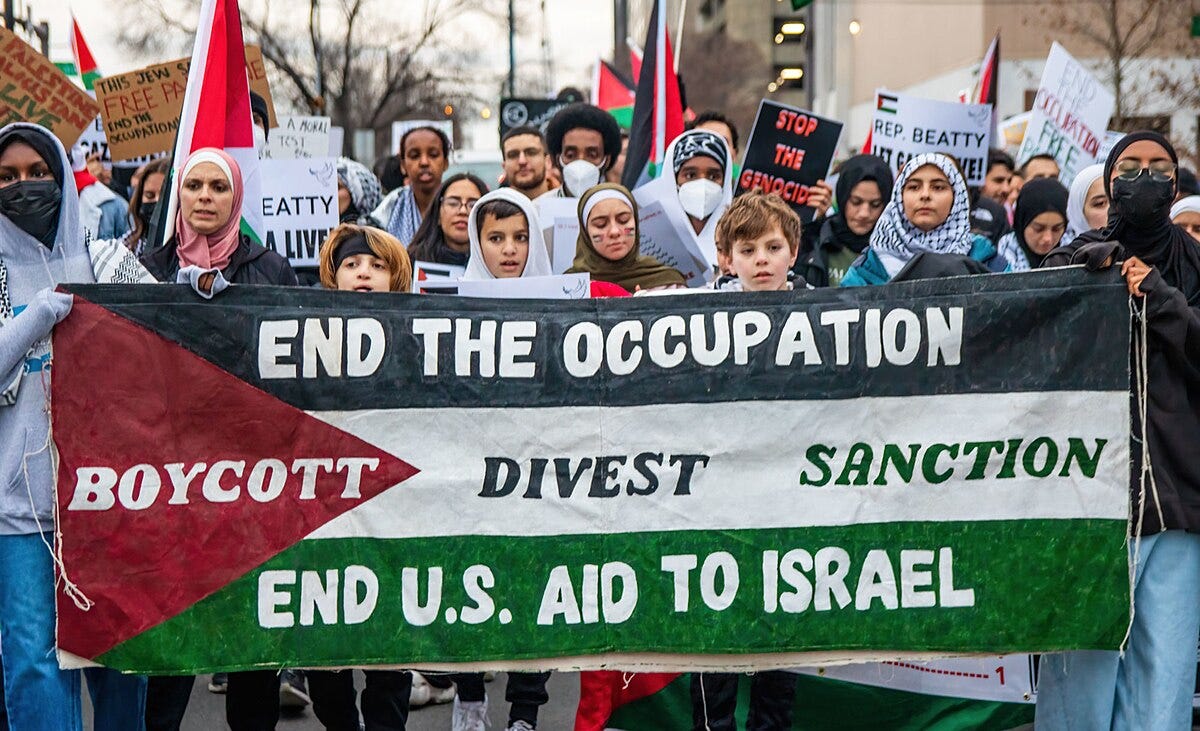
There is a reason that Israel has reacted as it has to any hint of Boycott, Divestment, and Sanctions (BDS). It is because economic pressure has always been the only way Israel is ever going to allow Palestinians the basic rights to which every human being is entitled.
Boycotts worry Israel even though they are well aware that boycotts in this day and age are not useful tools for change by themselves. In the global economy, where supply chains are long and often convoluted, goods are rarely sold in so simple a manner as a country producing them and exporting them for consumer sale overseas. Israeli products are often parts of other products. Or perhaps they only reach consumers after passing through several other states. Or, most often, people don’t even realize where the items they are buying originate from. All of this makes it much more difficult to get casual shoppers to avoid products from a particular country.
But boycotts are remarkably effective as a way of making people realize that a state is doing something to which they would object. Boycotts have been instrumental in exposing Israel’s massive crimes for years.
Ultimately, however, the real pressure comes not from the B, but from the D and the S. And that’s why, when students called for their universities to DIVEST from Israel the reaction was turned up a notch from the already wildly disproportionate hysteria.
Of course, while some universities do indeed contribute mightily to Israel’s economy in a variety of ways, the real worry is that international corporations and, perhaps even more crucially, financial institutions could find doing business with Israel so controversial that it is not worth it for them to continue doing so.
Israel isn’t a major exporter of its own resources. Its top export is diamonds, which it cuts from raw stones imported from other countries. It also exports a great deal of tech and pharmaceutical products and services. Agricultural and energy products (liquified natural gas has recently become a much more critical component of the Israeli economy) are secondary exports.
In other words, unlike a country like Ukraine, whose grain exports cannot be replaced, other countries could and would take up the slack if Israeli exports were shunned. This is why Israel is so panicked at the idea of divestment or sanctions. If such measures were taken, Israel would have to choose between changing its policies and behavior or face economic collapse.
There has never been a more opportune time to focus on that as a goal. As Sami Peretz, the editor of Haaretz’s economic publication the Marker wrote recently, “This is a very asymmetric war, and the images presently coming out of Gaza… will not leave the world indifferent. The easy way for the world to inflict punishment is via the pocket…[M]oves like that of Norway's Sovereign Wealth Fund, which is ending its investments in Israeli firms, will become more widespread. And the deeper and longer Israel's invasion of Gaza will be, the greater the damage.”
This is how Israel can be made to end its genocide, turn away from eternal war and slaughter, and finally commit to ending its own apartheid system. It is how Israel can be brought into a post-Zionist future where, within its borders—whatever they may eventually be, as Israel has never declared its own borders—Jews and non-Jews have truly equal civil, human, and national rights before the law. It’s not a utopian vision; there are still countless problems of reparations, laws, refugees, restorative justice, and many other concerns that need to be worked out. But it is how the path to a better future, and, more importantly for the moment, an end to genocide, begins. There needs to be a global movement to divest from Israel until it ends its genocide, its occupation, and its apartheid unequivocally.
My Recent Articles
VIDEO: Charlie Kirk and Political Violence
No one calling themselves progressive or left should celebrate killing. That must be clear. But neither should we tolerate whitewashing Charlie Kirk as key Democratic figures like Ezra Klein and Gavin Newsom are doing.
YouTube, September 11, 2025
Understanding Israel’s attack on Qatar, and what it means for the region
Mondoweiss, September 10, 2025
News Roundup
'God loves Gaza': US Christians gather in rare display of solidarity with Palestine
By Yasmine El-Sabawi, Middle East Eye, September 11, 2025
Encased in Amber: Biden’s wars and the unmaking of liberal foreign policy.
By Matthew Duss, The Nation, September 9, 2025
With the Doha strike, Netanyahu has declared war on the world
By Belen Fernandez, Al Jazeera, September 11, 2025
How Israeli strikes are compelling shift in Gulf security thinking
By Andreas Krieg, Amwaj Media, September 11, 2025
Qatar calls emergency meeting of Arab, Muslim states following Israeli attack
The New Arab, September 11, 2025
How Israel’s Gaza ‘disengagement’ planted the seeds of today’s genocide
By Daniel Levy, +972 Magazine, September 10, 2025
Netanyahu Signs E1 Settlement Plan, Declares ‘There Will Never Be a Palestinian State
Palestine Chronicle, September 11, 2025
The House Just Passed a Bill Punishing “Politically Motivated” Boycotts of Israel
By Matt Sledge, The Intercept, September 11, 2025
Hypocritical Conservatives Are Using Charlie Kirk's Horrific Murder to Cynically Smear the Left
By Mehdi Hasan, Zeteo, September 11, 2025
As always, follow me on:
Twitter @MJPlitnick or
Bluesky @mjplitnick.bsky.social for my latest hot takes, comments, and news updates.
I also post occasionally on these sites:
Threads @mjplitnick
Mastodon @MitchellPlitnick@journa.host
Instagram @mjplitnick