

US Declares War On International Law
The State Department's new threat to "dismantle" the ICC puts international law in the crosshairs but has equally worrisome implications for the rule of law in the U.S. as well.

Cutting Through is only sustained by your support. This work is not the product of major donors, merchandising, or grants. We need your support. If you can help and are willing, please consider becoming a paid supporter at the “subscribe” links in this newsletter. You can also make a one-time donation at the “One-time donation” links. Any help is deeply appreciated, as the support of those who are able will continue to keep this service free for newcomers and those who can’t afford to sustain independent reporting and analysis. Thanks to all of you.
My Recent Articles and Media
PODCAST: Globalists: The Mamdani-Polanski Experience
In this week’s Globalists, Josh White and Mitchell Plitnick unpack the rise of Zohran Mamdani in New York and Zack Polanski in Britain. One is redefining leftist politics within the Democratic Party; the other is mounting a serious challenge to Labour from the left. Despite fierce opposition and a backdrop of rising Islamophobia and Antisemitism, both have exceeded expectations and built growing political movements
The Battleground, July 13, 2026 (audio and video)
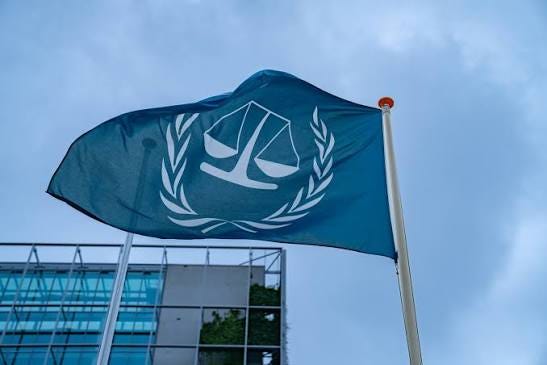
The United States has always opposed international law as it applies to ourselves. We have generally been at ease with using it against other states when it suits our interests, but we have always taken the position that we are above the law, as are any of our allies whom we decide to bring under our protective umbrella.
In recent years, it has become clear that, with the International Criminal Court (ICC) launching high profile investigations into Israeli behavior in the Palestinian territories and American actions in Afghanistan, the U.S. has begun to question if that tool we occasionally use is worth the trouble.
Today, Marco Rubio declared that it decided it is not.
The State Department announced the launch of a campaign to effectively destroy the ICC. In its press release, it stated: “Today, Secretary of State Marco Rubio announced a sweeping campaign to dismantle the threat posed by the International Criminal Court to U.S. sovereignty…The ICC poses an intolerable threat to U.S. sovereignty – it claims the authority to prosecute and even imprison American servicemen and officials operating on behalf of America’s national interest. Americans never signed up for this, and all American presidents since the ICC’s ratification have maintained that the ICC does not have jurisdiction over Americans…The ICC now seeks to become the unaccountable global arbiter – positioning itself above and beyond the nation state as a supranational enforcement arm of a globalist bureaucracy empowered to persecute American servicemen and officials at will.”
It is certainly true that the United States did not “sign up” to allow ICC jurisdiction. The principles the ICC operates under, however, include the concept of “universal jurisdiction,” which allows the court to prosecute war criminals regardless of where the crime was committed and whether the accused is a citizen of a member state of the ICC or not.
It’s a sensible principle considering that when the Rome Statute which created the ICC was adopted at the UN General Assembly only seven states voted against it (three of them have self-identified, and, unsurprisingly, they were China, the U.S., and Israel). By now, 125 states are parties to the Statute.
But the argument that universal jurisdiction violates state sovereignty is not new. It is the basis for American and Israeli opposition to ICC jurisdiction. What is new is defining the very existence of the Court as an impingement on such sovereignty, as State does here.
State’s objection to the ICC is that it claims, accurately, to be “a supranational enforcement arm of a globalist bureaucracy.”
That is the very definition of the rule of law. The whole point of rule of law is that it was meant to supersede the rule of kings, creating a principle where even the head of state is subservient to the law.
The purpose of the ICC is to deter and prosecute international crimes which fall into four categories: genocide, crimes against humanity, war crimes, and the crime of aggression.
It quickly becomes clear why the U.S. and Israel (and, yes, China too) hate the ICC when you see that list.
Now the United States has effectively declared war (one of our favorite things to do) on the ICC.
The U.S. is threatening to increase sanctions on ICC personnel, and on affiliated organizations. It plans also to press countries that have ratified the Rome Statue to renounce that ratification.
Not just the ICC, but the rule of law itself
Even beyond the supremely crucial issue of international law, this action has ramifications for Americans domestically too.
We have already seen the contempt in which this administration holds the rule of law. It’s not unique in this regard—one need only look at how Trump’s predecessor, Joe Biden, trampled U.S. law, including some provisions that were enacted by his own administration, in order to partner with and fully enable Israel’s genocide in Gaza.
But the degree to which Donald Trump’s administration has spit in the face of the rule of law is unprecedented in living memory. Now they’re making it even more explicit.
The notion that the rule of law is an impingement on state sovereignty is being used here in the context of international law. But it’s a short step from that idea to one that Trump has expressed before—that the “American people” elected him and so the Courts and Congress should not be restraining him from doing what he wants.
The Trump war on international law is quite different from, for example, the objection Henry Kissinger (unsurprisingly) had to universal jurisdiction. Kissinger primarily argued that it was impractical because an accused person could be tried in a system with which they were unfamiliar, and that legal zeal to prosecute war criminals could undermine political reconciliation processes. We’ll leave it there, rather than speculate about Kissinger’s own self-interest in opposing universal jurisdiction.
But that’s not the case that the State Department makes at all. Rather, it is arguing that Americans are simply above accountability. State’s claim is that the ICC is an intolerable impingement on American sovereignty because “it claims the authority to prosecute and even imprison American servicemen and officials operating on behalf of America’s national interest.”
There is no exception stated here for the actual commission of war crimes or crimes against humanity, nor any commitment to abide by international law regarding such crimes.
One might argue that there is already American law that forbids such acts. But that argument doesn’t stand up well under scrutiny.
Universal jurisdiction is supposed to be a fallback option, exercised only if the country that should have direct jurisdiction is either incapable or unwilling to prosecute the accused. But the United States has proven itself to be unwilling on multiple occasions to hold its service members accountable.
Consider Navy SEAL Edward Gallagher, Army 1st Lt. Clint Lawrence, and Army Major Matthew Golsteyn. All three of them were accused of war crimes, all including murder, after having complaints filed against them by their own troops. Gallagher was acquitted and restored to his full rank after intense lobbying by Pete Hegseth; the other two were pardoned by Trump.
It’s also well known that this administration disdains any sort of restraint on military or security forces. They’ve made that clear often enough.
So, they’re not using Kissinger’s argument, but a much blunter one: in the pursuit of American interests, there will be no prior restraints on American forces.
We’ve already seen how that translates into domestic action, in the deaths of Lorenzo Salgado Araujo, Ruben Ray Martinez, Alex Pretti, Renee Good, Silverio Villegas Gonzalez, Jaime Alanis, Roberto Carlos Montoya Valdez, Josue Castro Rivera, and Joan Sebastian Guerrero who was killed by ICE Monday morning.
Just like the unabashed murders of people on the high seas, who are claimed to be drug traffickers (which is not an executable offense) with no evidence to support those claims, we are faced with an utterly lawless administration.
This attack on the ICC is the next step in the Trump administration doing away with the rule of law, and it’s arguably the most brazen. It needs to be stopped, whether or not you support the idea of the ICC.
News Roundup
Syria, Iraq and US plan to unveil Mediterranean pipeline deal to bypass Strait of Hormuz
By Sean Mathews and Ragip Soylu, Middle East Eye, July 11, 2026
Tension rising as Yemen gov’t attacks Sanaa airport, Houthis fire missiles
Al Jazeera, July 13, 2026
The viral Arabic media outlet hiding its ties to Israel
By Yossi Bartal and Amin Al Magrebi, +972 Magazine, July 13, 2026
The New Israel-Backed Nonprofit Feeding Lawmakers Model Legislation
By Matthew Petti, Drop Site News, July 13, 2026
New round of Lebanon-Israel talks to begin on Tuesday
The New Arab, July 13, 2026
Euroskeptics in France, Germany suddenly gain steam in elections
By Molly O’Neal, Responsible Statecraft, July 13, 2026
‘My Father is Bleeding’: Israeli Guard Shoots Marwan Barghouti at Point-Blank Range
Palestine Chronicle, July 13, 2026
Sudan court sentences RSF leader to death in absentia
By Adel Abdelrheem and Tarek Chouiref, Anadolu Ajansı, 13 July 2026
Hormuz: High AC Costs as UK Heat Wave kills Thousands
By Juan Cole, Informed Content, July 13, 2026
Hamas rejects UN official’s accusation of Gaza aid obstruction
Arab News, July 13, 2026
Crimea was Russia’s stronghold. Now it’s a vulnerability.
By Lily Hyde, Politico.eu, July 14, 2026
For professional information and contact:
LinkedIn: https://www.linkedin.com/in/mitchell-plitnick-616ba5
For my latest hot takes, comments, and news updates follow me at:
Facebook: https://www.facebook.com/MitchellPlitnick
Twitter @MJPlitnick or
Bluesky @mjplitnick.bsky.social
I also post occasionally on these sites:
Mastodon @MitchellPlitnick@journa.host
Instagram @mjplitnick
Very sad.
I completely agree with the thrust of this article.
I believe you have, however, overstated the extent of the ICC’s jurisdiction, and that could weaken your argument. As I understand it, the ICC does not have jurisdiction over war crimes and crimes against humanity regardless of where the crime is committed. Rather, the ICC has jurisdiction over crimes committed by citizens of a country that is a member of the ICC, and also over crimes committed in a country that is a member of the ICC, even if the perpetrator is from a country that is not an ICC member. That’s what gives the ICC jurisdiction over crimes committed in Palestine - which has joined the ICC - by citizens of the US - which has not joined.